
Photo : Leandro Paes Leme (Pexels)
By Beatrise Briede,11th November 2026
A Democratic wave in the midterms has upended Washington, flipping Congress blue and creating a contentious divided government for President Trump. As a disgruntled White House braces for legislative deadlock, European leaders are closely calculating how a constrained US executive will reshape foreign policy, trade, and global security commitments.
Midterms in the USA
On the 3rd of November Americans marched to the polling stations to put in their vote for the Senate and House of Representatives, which take place every two years, right in the middle of a president’s four-year term. The House serves two-year terms (all seats are up), while the Senate serves six-year terms (roughly one-third of seats up for election every two years), ensuring political stability and relevance in Congress. With these elections come a lot of uncertainties regarding transatlantic ties, European leaders only hoping for the best outcome for the remainder of President Donald Trump’s office.
The elections have caused outrage at the White House with Trump posting on his Truth Social platform : “I JUST WASN’T ON THE BALLOT. IF I WERE, WE WOULD HAVE WON IN A LANDSLIDE!” His disbelief of the voting results also sparked conspiracies – President Donald Trump posted “Does anybody really believe that this “Election” was honest. How could the Polls be so wrong??? Some early voting “dumps” were so large that it was impossible to win, no matter how many people went to vote.”

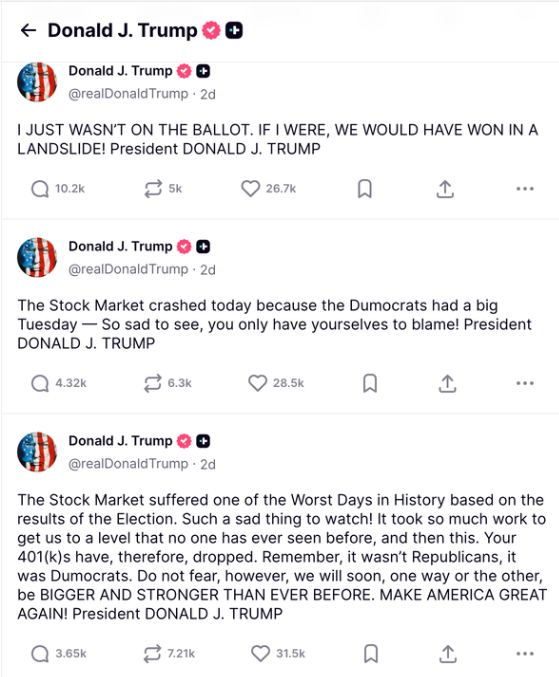 Donald Trump on Truth Social
Divided opinions across European capitals
European leaders have responded to the US midterms with a mix of celebration and caution. The consensus in capitals like Paris, Madrid, Warsaw, and Brussels has largely leaned positive. Spain’s Prime Minister Pedro Sánchez hailed on his X platform the midterm outcome as proof that the « far right wing is crumbling », while French Foreign Minister Jean-Noël Barrot rejoiced in the National Assembly, declaring, « This is very good news for American democracy ». Polish Prime Minister Donald Tusk also welcomed the prospect of shifting US foreign policy at a press conference in Warsaw.
Other European decision-makers and analysts urge caution. German Chancellor Friedrich Merz pointed out a vital reality in his speech at the Social Democratic Party (SPD) Economic Forum last Wednesday: « Trump has (for the past two years) also largely governed without consulting Congress ». Echoing this skepticism, policy analyst Javier Carbonell noted that European powers should not expect a major foreign policy turnaround, emphasizing that the president’s veto powers can still be leveraged aggressively against the Democratic majority.
Far-right leaders retreat
The midterm results also forced Europe’s far-right leaders, such as France’s Marine Le Pen and Italy’s Giorgia Meloni, to distance themselves from Donald Trump. Rather than tying their political fortunes to a struggling US administration, populist figures worked to emphasize their own national agendas.
Analysts warn mainstream European parties against viewing the Republican defeat as the end of populism. Because European voters remain focused on local economic pressures like inflation and the cost of living, domestic political discontent will persist regardless of Washington’s political shifts.
Race against the clock
Europe must now navigate two years of political turbulence and uncertainty, starting immediately. All eyes are on the trilateral peace talks that opened in Abu Dhabi on Tuesday. In this high-stakes window, Russia may push for negotiations favorable to Moscow, hoping to lock down concessions from a pressured White House before the newly elected Congress officially takes office in January.


